Parsi Textiles
Parsi Silk Textiles
Costume of Parsi Women
Costume of Parsi Men
Parsi Silk Textiles
Parsi Silk Textiles
The Parsis are famed for introducing two silk textiles to India, the Tanchoi and the Gara. Both are connected to the Parsis not just because their trading families imported these textiles to Mumbai from China but because, inexplicably, for more than a century, these silk saris were worn only by Parsi women until more recent times.
The Tanchoi silk is named after three brothers who were sent to China by the First Sir Jamsetjee Jejeebhoy to learn the art of Amru brocade weaving. Tan meaning three and Choi is probably the name of the master craftsman who taught the Parsis how to weave this silk. The popular understanding interprets the name as the three brothers of the Joshi family, who went to China to learn the art of weaving this kind of silk brocade. The Tanchoi silk is a sateen weave in which the coloured warps and wefts produce a lustrous surface colour. The absence of loose thread on the reverse is a mark of this weave. Tanchoi saris woven with white silk thread, featuring floral designs in muted gold or silver were worn by Parsi women as wedding saris.
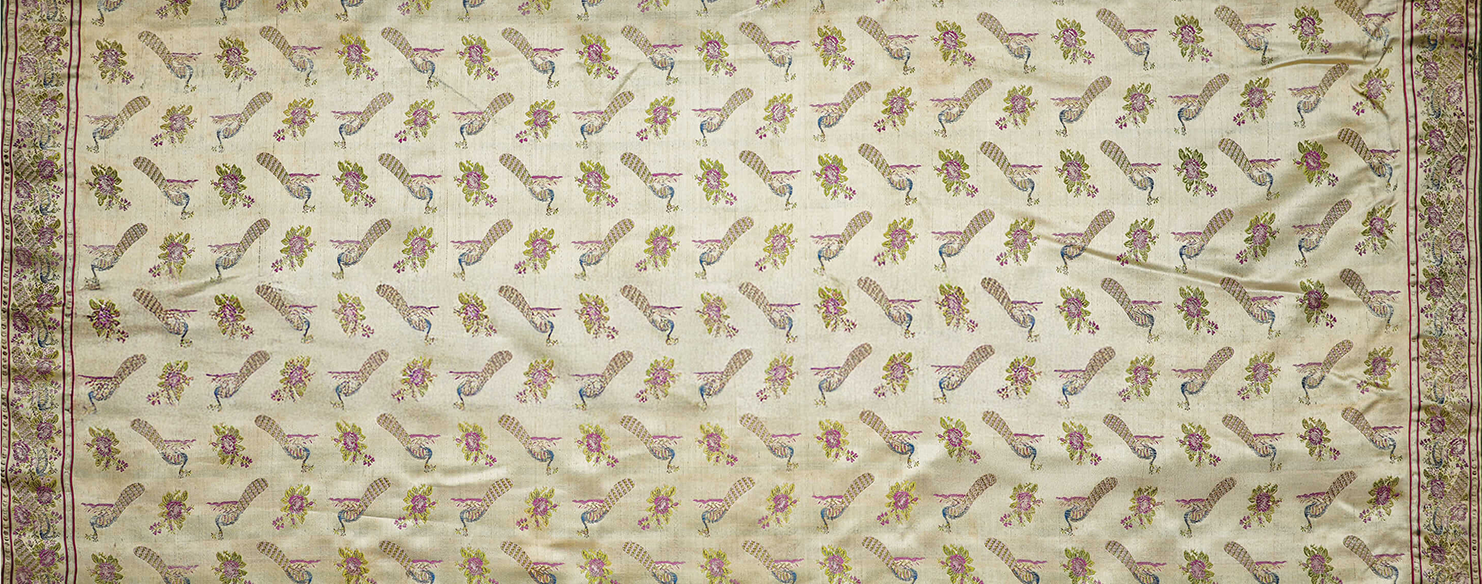
Over a 170 years old Ivory silk Tanchoi saree with peacock motifs from the Sir Jamshetjee Jeejeebhoy family crest.
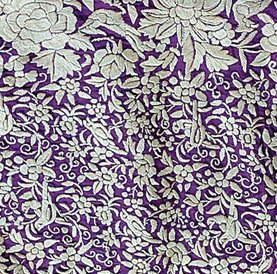
Another silk textile is the embroidered Gara. The Gara saris are densely embroidered with birds, flowers, butterflies, Chinese symbols and sometimes depict Chinese social scenes. The embroidery is usually done with twisted white or variegated silk thread, which gives the embroidery a slightly raised effect. The early Garas were bought by the yard from China and had to be lengthened by stitching a panel of silk cloth along the length of the saree. As Garas became popular, they were woven in sari lengths and embroidered in China.
Later the garas were embroidered in Surat on translucent silk material imported from China. Gara silk was a finely woven silk gauze in shades of red, maroon, purple and black, with a lustre that allowed the white embroidery to stand out.
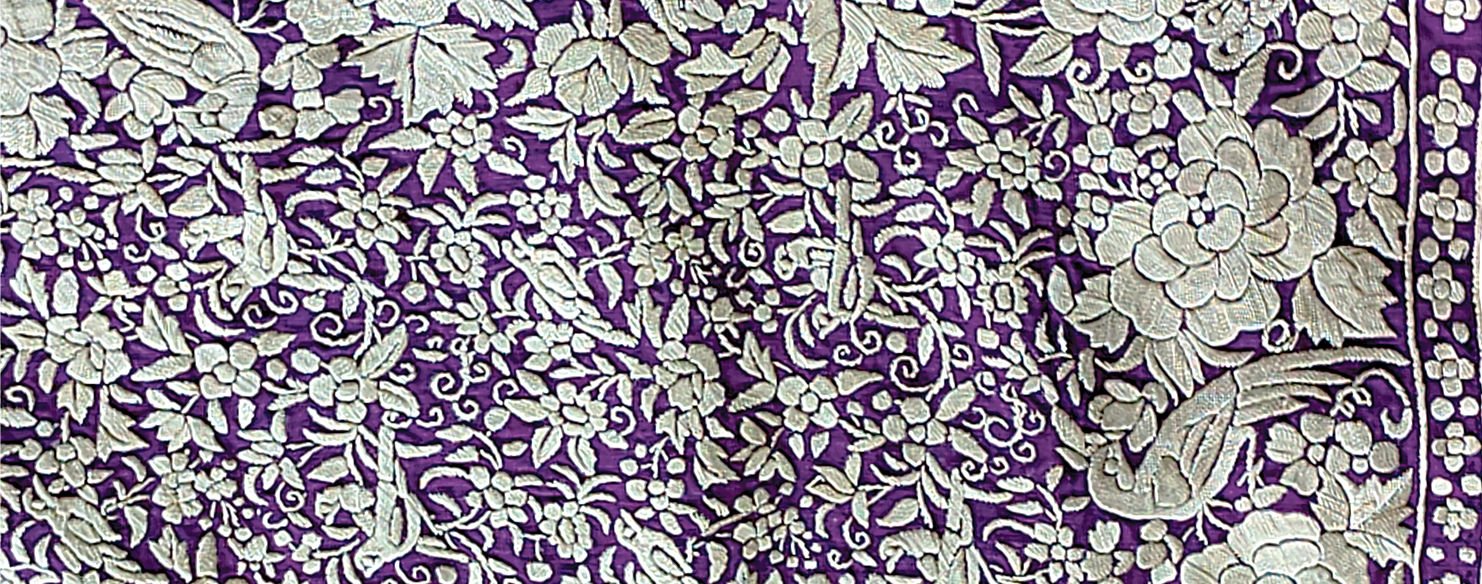
Heavily decorated Gara depicting flowers and birds with a floral border punctuated with dots, © Kerman R Fatakia
Costume of Parsi Women
Costume of Parsi Women – Gara Sari
The flourishing 19th century trade with China introduced new textiles in India, for the Parsi community. Parsi China traders were fascinated by the translucent silk-length embroidered with twisted white or variegated silk thread to give a raised effect to the motifs. Such sarees were called garas and were brought as gifts by Parsi-China traders.
Parsi women wore the gara sarees traditionally with white long-sleeved blouses in Edwardian style, embellishing their garments with pearls and other jewellery. The garas are treasured heirlooms worn by Parsi women on special occasions.
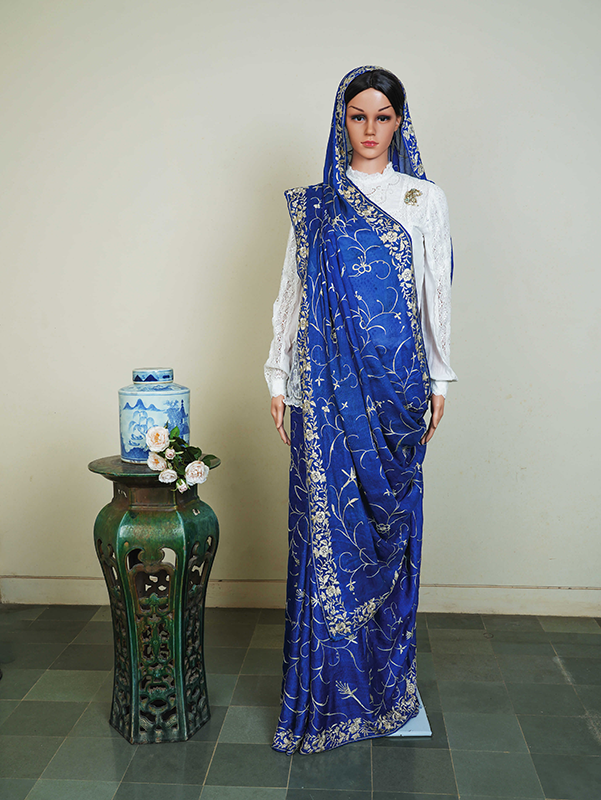
An unusual lapis lazuli colour gara with the ground covered with flowering vines and flowers and a border to enhance its beauty.
Embroidered silk Saree – Gara, India, 20th century,
Collection F. D. Alpaiwalla Museum, Donated by Dastur (Dr.) Firoze M. Kotwal
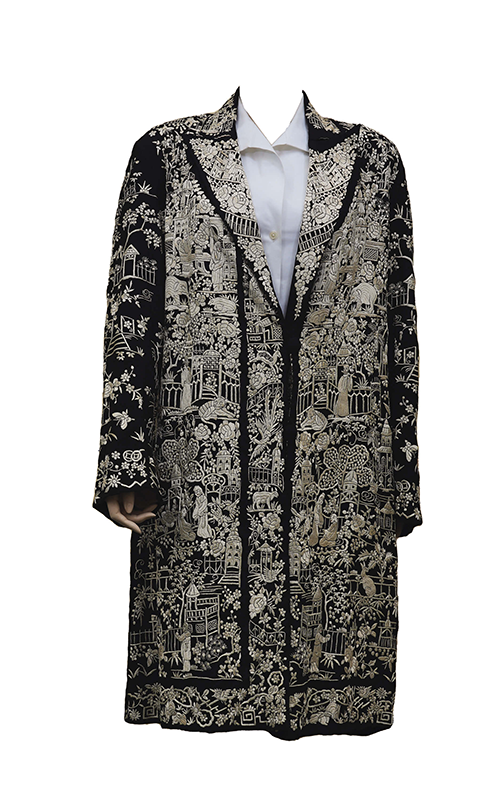
Black Silk Coat with Gara Embroidery. An evening coat, embroidered in Gara style, depicting Chinese figurines strolling in a garden dotted with pavilions, pagodas and flowering trees; with deer, monkeys, dogs, elephants and lions lurking in the dense foliage. Depiction of exotic animals on textiles, became popular after the establishment of the Royal Geographical Society of UK in 1830.
Collection F. D. Alpaiwalla Museum, Gifted by Ervad Meher Modi
Costume of Parsi Men
Costume of Parsi Men
During the late 19th and early 20th centuries, Parsi men cultivated a distinctive style unique to their cultural identity. This sartorial evolution began with traditional, ankle-length Zoroastrian robes that crossed over the chest, fastened with ribbons, and gathered at the waist with a cummerbund. Over time, this flowing attire was modified into the Dagli, a knee-length, straight-cut white coat that retains the traditional buttonless design, secured with broad ribbon bows tied over white trousers.
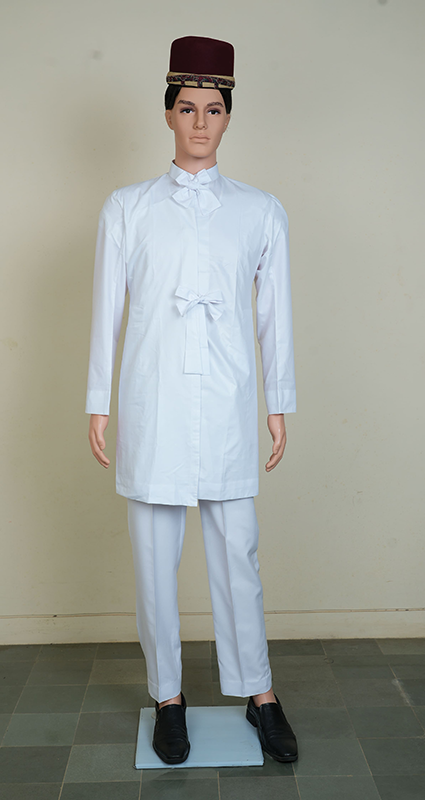
A model of a Parsi man wearing a traditional dagli. This garment is crossed over at the chest and has no buttons. It is held together by two sets of ribbons tied into bows. It is worn on celebratory occasions.
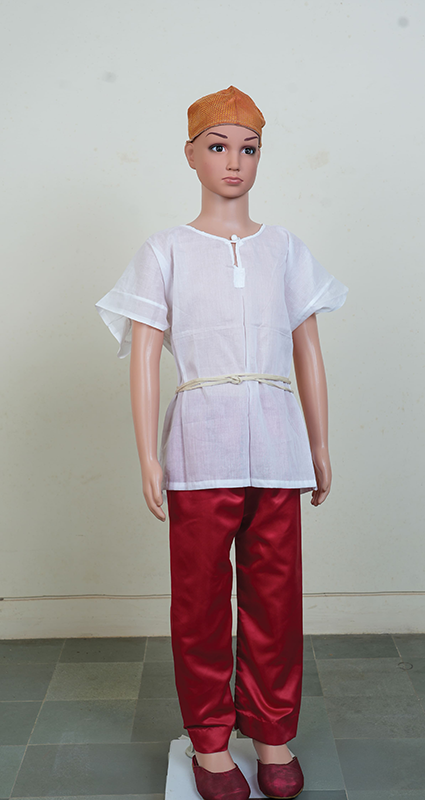
A model representing a Parsi child dressed in a sacred undershirt (sudreh) with a sacred cors (kusti) worn around the waist. His head is covered in a soft prayer cap made of Tanchoi material.
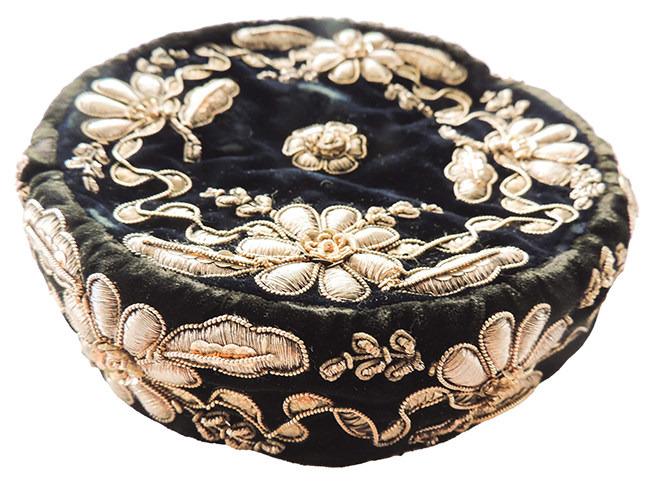
Delicately embroidered Blue Prayer cap.
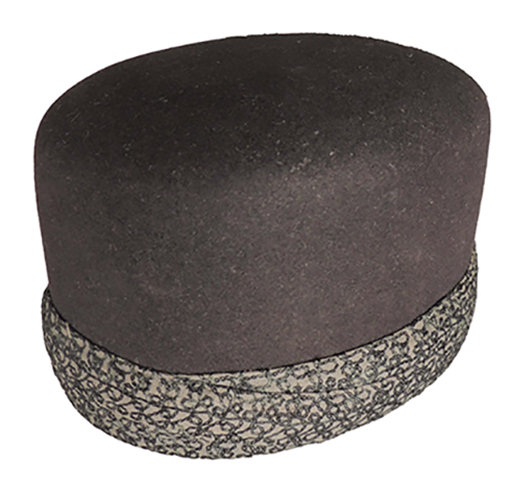
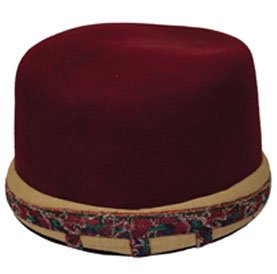
The headgear worn by Parsi men evolved over a period of two hundred years from rolled turbans worn in their own style to paghris made and shaped with straw and cardboard. The one seen here is the hat that is inspired by an English bowler.
For formal and ceremonial occasions, some men adopted the Daglo, a structured overcoat crafted from thick cotton that featured large buttons, pockets, and occasionally a Mandarin collar. Both these unique garments were traditionally completed with distinct headgear—either the structured Pagdi, made of cardboard and straw wrapped in dark indigo cloth and lacquered or the Pheta, a hat inspired by the English bowler and trimmed with embroidered woollen shawl material—alongside a classic pocket watch and fob chain was a common part of a Parsi man’s attire.